
Singapore finance weighs AI agents against governance gaps
A proposed framework sets controls for artificial intelligence actions at runtime.
An artificial intelligence (AI) agent at Oversea-Chinese Banking Corporation Ltd. (OCBC) has cut the time needed to produce a source of wealth report to about an hour from 10 days, showing how financial institutions can use autonomous systems for document-heavy work as governance rules take shape.
The tool reviews client documents, extracts key information, assesses a client’s wealth profile and prepares a draft report. Relationship managers remain responsible for reviewing, validating and refining the output.
The technology is spreading across Singapore’s financial sector. A February survey by Finastra Ltd. found that 64% of financial institutions in Singapore are actively deploying AI across key business functions.
The Ministry of Manpower’s inaugural report on AI adoption among firms, published in April, put adoption in the financial and insurance service sector at 56.4%.
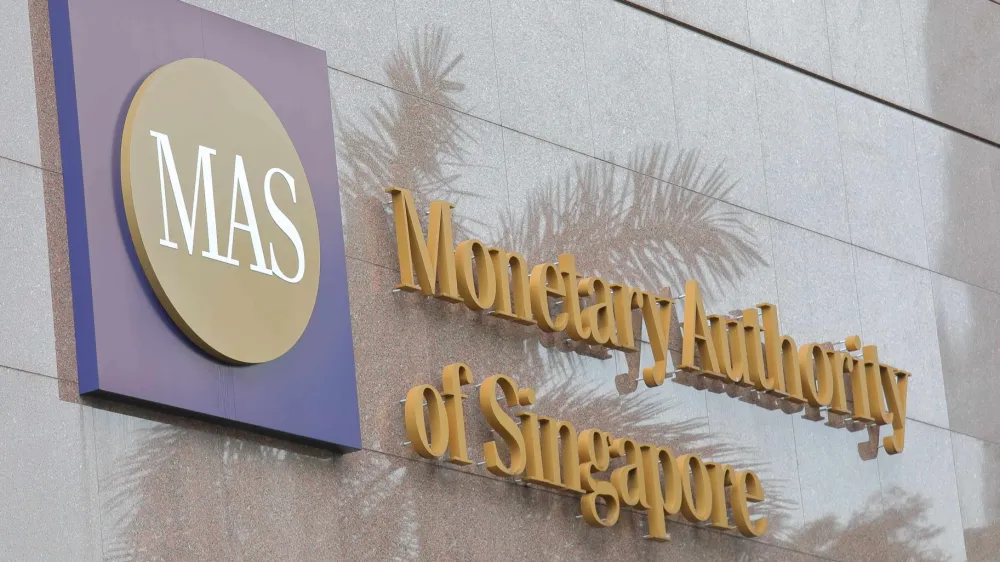
The Monetary Authority of Singapore (MAS), financial institutions and fintechs published the Safeguards for Agentic Finance at Runtime white paper in July to provide a framework for deploying AI agents with controls over their actions.
“The underlying foundation models were not built with the enterprise controls financial institutions require everywhere else,” Suyeol Yun, head of AI at LinqAlpha, said in an emailed reply to questions. “They have no native concept of entitlements, no built-in audit trail, and no awareness of information walls or material nonpublic information.”
Yun said the framework could help institutions move AI agents from experiments into production for narrowly defined tasks, including routine operations, document review and drafting client materials. He added that predefined mandates and post-action reviews could give banks greater control over agent behaviour.
“When safeguards are developed with the industry and publicly documented, an institution deploying agents follows an emerging standard rather than taking a solo bet,” Yun said. “This matters enormously in a sector where reputational and regulatory risk dominate decision-making.”
At OCBC, the safeguards’ runtime controls are applied whilst the source of wealth agent works on a client file.
“The Safeguards for Agentic Finance at Runtime introduce a structured checkpoint that evaluates every proposed agent action before execution,” Dr Jingyuan Zhao, head of group data office at OCBC, said in an emailed reply to questions. “The key shift is moving from predominantly pre-deployment governance to continuous governance at runtime.”
The framework still leaves gaps in areas where AI agents interact with other systems or institutions, Yun said. These include multi-agent workflows, cross-institutional interactions, and cross-border data residency requirements.
He also said financial institutions need common standards for evaluating agents before deployment, rather than relying only on controls applied when an agent takes an action.
Bryan Keasberry, head of market development for the Asia-Pacific region at Fenergo Ltd., said the white paper provides clearer guidance for decisions with defined limits, such as transaction thresholds, but is less prescriptive for processes requiring human judgment.
Assessing how a client accumulated wealth or determining investment suitability involves multiple factors that cannot easily be reduced to fixed rules.
He said those cases should be incorporated into the framework to support broader use of AI agents in client onboarding and Know Your Customer processes.
SAFR is not binding regulation, Keasberry said, leaving its impact dependent on how widely financial institutions adopt the framework.
Yun expects AI agents to take on broader operational roles as those controls develop.
“We think of this as AI becoming a ‘second brain’ for every knowledge worker in finance,” he said. “Governance frameworks are what make that future deployable: autonomy without accountability was never going to be acceptable in this industry, and clear guardrails are the path to having both.”











 Read Here
 Advertise
 Sign Up