China bank recapitalisation hits weak credit demand
Capital injections will strengthen major banks’ buffers, but subdued household and corporate borrowing remains the bigger constraint on loan growth.
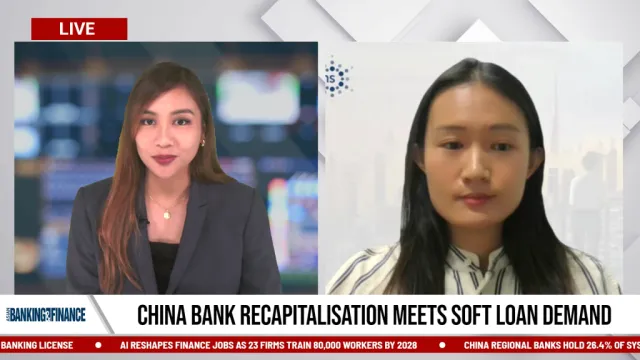
China’s planned capital injections into major financial institutions could strengthen banks’ balance sheets but are unlikely to materially accelerate lending without a recovery in credit demand, according to CreditSights.
Karen Wu, Senior Analyst for APAC Financials at CreditSights, said the support is widely viewed as a way to encourage lending to the real economy. Its primary purpose, however, is strengthening large banks’ capital positions ahead of total loss-absorbing capacity (TLAC) requirements.
Whilst China’s largest banks generally maintain comfortable capital buffers, Wu said TLAC buffers are tighter, particularly at Agricultural Bank of China, ICBC, and Bank of Communications.
Low interest rates and narrowing net interest margins have also reduced banks’ ability to generate capital organically through profits.
“The capital injections may improve the banks’ capacity to lend, but whether lending will actually increase will depend much more on credit demand than on the availability of banking capital,” Wu said.
Weak demand is already weighing on lending. China recorded its slowest first-half loan growth since at least 2019 in the first half of 2026, Wu said, despite several major banks receiving capital injections in an earlier round.
Major banks have continued to outpace smaller peers in loan growth, but much of that expansion has been driven by discounted bills rather than longer-term loans associated with real economic activity.
A meaningful credit recovery therefore depends on stronger borrowing appetite from households and companies.
Wu said household demand would require higher salaries, a stabilising property market, and improved consumer sentiment. Companies are more likely to borrow when client demand strengthens and investment returns become more attractive.
Improved household confidence could consequently support corporate borrowing, whilst additional government fiscal stimulus would also be needed to underpin a broader recovery in credit demand.





















 Read Here
 Advertise
 Sign Up







Commentary
Singapore's next payments opportunity
DIFC's reforms open new doors for Asian businesses: Is yours ready?
Why Asia’s private wealth industry requires a new era of governance
APAC has mastered domestic payments. The next challenge is connecting them.
Why fragmented communications are becoming a hidden governance risk for Asia Pacific banks
From automation to agency: Asia’s wealth leaders can reinvent, not just streamline
Singapore aced its FATF evaluation — now comes the hard part